Posts

List of Wall's Chess Blogs and Stories

Image
  19 th century chess – Nov 8, 2020 2001 A Space Odyssey – Nov 8, 2020 Abrahams, Gerald – Nov 8, 2020 ACM computer chess – Nov 8, 2020 Actresses and chess – Nov 11, 2020 Addict, chess – Nov 14, 2020 Addison, William – Nov 7, 2020 Advertising and chess   - Nov 8, 2020 Age players learned chess – Nov 18, 2020 Ajeeb the automaton – Nov 8, 2020 Alekhine, Alexander – Nov 8, 2020 America, early and chess – Nov 12, 2020 Anderssen, Adolf – Nov 6, 2020 Anecdotes, chess – Nov 10, 2020 Annoy your opponent – Nov 15, 2020 Antarctica and chess – Nov 7, 2020 Archaeology and chess – Nov 8, 2020 Armed Forces chess – Nov 7, 2020 Asimov, Isaac and chess – Nov 8, 2020 Astronauts and chess – Nov 7, 2020 Astronomy and chess – Nov 12, 2020 Athletes and chess – Nov 10, 2020 Atwood, George and chess 0 Nov 11, 2020 Automobiles and chess – Nov 12, 2020 Bans in chess – Jan 11, 2021 Baseball and chess – Nov 7, 2020 Bedlam and chess – Nov 12, 2020 Bene...
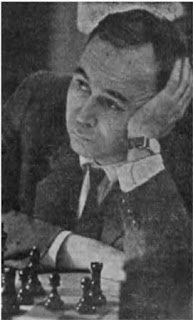
Yuri Sakharov (1922 – 1981)

Image
  Yuri Nikolaevich Sakharov ( Ю́рій Микола́йович Са́харо ) was born on September 18, 1922, in Yuzovka (Stalino since 1924, and now Donetsk, Ukraine since 1961).   Other sources have him born in the village of Vlasovka, Voronezh Oblast, Russia, over 300 miles away. His father, Nikolai Matveevich Sakharov (1881 – 1937), was an official in the Donbass mining industry in Ukraine.   Yuri was his only child.   His mother, Alexandra Afanasievna Yumashev, was a housewife and, later, worked in a sewing factory cutter.  In 1934, Yuri learned how to play chess from his father.  In 1938, Yuri took his first chess lessons from from Apollinary Nikolaevich Gaevsky (1897-1990), a physics and math teacher and strong chess player from Donetsk, Ukraine.  He played in the first Ukrainian chess championship, held in Kiev in 1924.  He also played in the second Ukranian championship, held in Kharkov in 1925. In 1938, Sakharov’s father was arrested, proclaimed as...

Chess Patrons

Image
  Faneuil (Fan) Adams, Jr. (1923-1999) was a former senior executive with the Mobil Oil Corporation and former president of the American Chess Foundation (ACF) which later became the Chess-in-the-Schools.  He was also the Treasurer and Director of the Manhattan Chess Club.  He served as a delegate to FIDE, representing the USA.  He was an unpaid, full-time volunteer for chess.  He set up chess programs for 160 schools, mostly in inner-city areas, and helped send teams to national scholastic competitions.  He was a direct descendent of Samuel Adams.  When he died of a brain tumor, he bequeathed a donation of 80% to Chess-in-the-Schools, which he founded, and 20% to the Manhattan Chess Club.  His will stated that if the Manhattan Chess Club were to go defunct, this 20% would go back into the Chess-in-the-School for their general use.  A year after Adams’ death, Chess-in-the-Schools evicted the Manhattan Chess Club from its b...

Carl Jaenisch (1813-1872)

Image
  Carl Friedrich Andreyevich von Jaenisch (pronounced YAY-nish) was born in Vyborg, Russia (50 miles northwest of Petersburg, close to Finland) on April 11, 1813.   Carl had 6 siblings. His father, Andreas, died in 1832 and Carl was raised by his uncle, Karl, a surgeon.     He began a military career in Finland, and then moved to Russia to teach mechanics in Petersburg.  Jaenisch attended the Institute of the Corps of Railroad Engineers.  In 1837, he published Decouvertes sure le cavalier (aux echecs).   In 1838, he was an engineer and major in the Russian army.   He was professor of mechanics at the Railway Institute. In 1838-39, he played a correspondence match with Lionel Kieseritsky, winning 1 game and drawing 1 game.     In 1840, he left the Russian army to concentrate full-time on chess.   Unable to support himself fully through chess, he worked in the Russian Ministry of Finance.     In 1842, he vi...

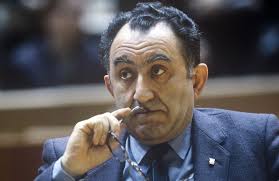
Tigran Petrosian (1929-1984)

Image
  Tigran Vartanovich Petrosian was born in Tiflis (Tbilisi), Soviet Georgia, on June 17, 1929 to Armenian parents.   His illiterate father, Vartan, was a refugee from Turkey.   [source: Chess Life & Review , May 1976, pp.271-273] He learned the game of chess from his parents when he was 8 years old (other sources say he learned at age 11 in the Young Pioneers). He won a few junior events and local tournaments in Tbilisi. At 12 years old, Petrosian began training at the Tiflis Palace of Pioneers.  His first coach was Archil Ebralidze (1908-1960), a chess master who won the Georgian Championship in 1938, 1939, 1941, and 1946.   Petrosian’s father discouraged him from playing chess, saying it was a waste of time.   His father warned Tigran and said to him, “Study!   You won’t earn your bread from chess.” In the June 1942, Petrosian was able to draw with Salo Flohr (1908-1983) in a simul.   That year he made friends with David Bronstein and ...